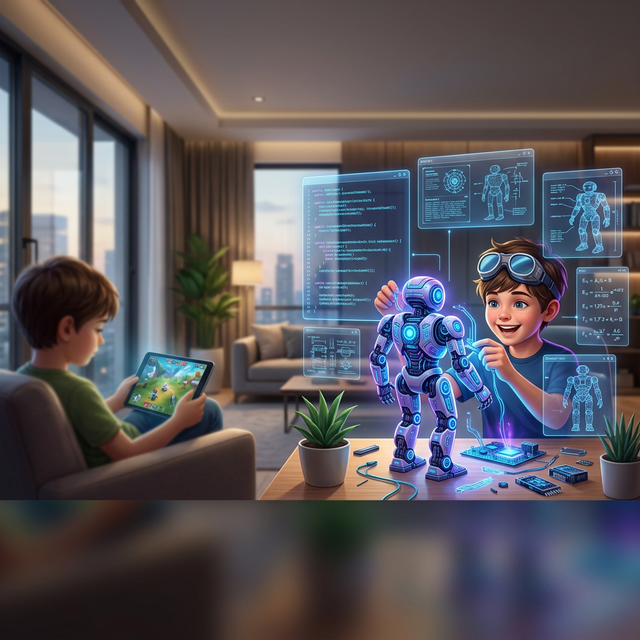
Screen Time vs. STEM Time: How to Turn Your Child's Digital Addiction into a Career in Engineering
The Myth of "Bad" Screen Time
Not all pixels are created equal. Watching endless algorithm-driven short videos is scientifically linked to shortened attention spans. However, building a 3D model in Blender, debugging a Python script, or designing a circuit in a virtual lab is a cognitively demanding exercise that mirrors the work of top-tier engineers.
1. Identify the "Consumer" Traps
The first step is identifying when screen time is passive. If your child is scrolling through feeds or playing games that offer instant gratification without strategy, they are in a "consumer" state. Our goal is to introduce tools that require "producer" logic.
- Instead of Roblox: Try Roblox Studio (Game Development).
- Instead of YouTube Shorts: Try DaVinci Resolve (Video Engineering).
- Instead of Social Media: Try GitHub (Collaborative Coding).
2. Gamifying the Engineering Mindset
Children love games because of the feedback loops. Engineering is simply a series of complex feedback loops. By framing a coding bug as a "puzzle to be solved" rather than a "mistake to be fixed," we tap into the same dopamine pathways that keep them glued to consoles, but with a productive outcome.
3. The Hikmah Approach: Purpose Over Pixels
At HikmahSTEM, we don't just teach the "How," we teach the "Why." When a child understands that their coding skills can solve a community problem or reflect the order and beauty of Allah's creation, the screen transforms from a toy into a tool of service.
4. Your 7-Day Transition Roadmap
Ready to start? Here is a simple framework to shift the dynamic in your home:
The "Shift" Schedule:
- Day 1-2: Audit. Observe and categorize current screen usage.
- Day 3: Introduction. Show them a "Creation" tool (like Scratch or Tinkercad).
- Day 4-6: Project Phase. Set a small goal (e.g., "Make a character move").
- Day 7: Showcase. Let them present their "invention" to the family.
Start Their Engineering Journey
Don't just limit screen time—maximize its potential. Enroll your child in our expert-led STEM programs today.